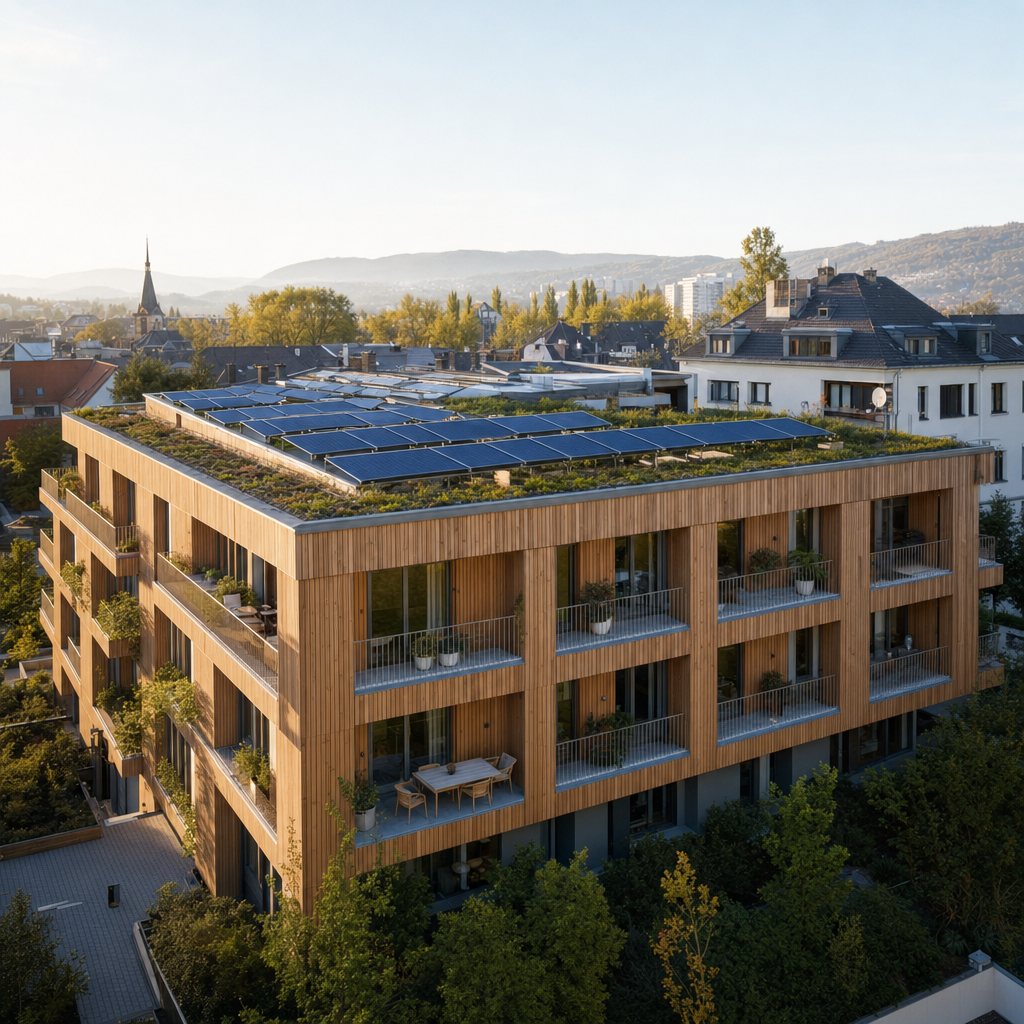
How the recast EPBD defines zero-emission buildings, when the standard becomes mandatory for new construction and how it replaces the NZEB benchmark.
The recast Energy Performance of Buildings Directive, Directive (EU) 2024/1275, replaces the nearly zero-energy building (NZEB) benchmark with a stricter target: the zero-emission building, or ZEB. It is the standard every new building in the EU will have to meet by the end of the decade, and the reference point for what the whole building stock is expected to become by 2050.
What counts as a zero-emission building
The directive defines a zero-emission building as one with very high energy performance, in which the very low amount of energy still required is fully covered by renewable energy where technically feasible, and which causes no on-site carbon emissions from fossil fuels. Operational greenhouse gas emissions must be zero or very low.
In practice that means three things at once. The building envelope and systems must keep demand low; the remaining demand must be met from renewables, whether generated on site, nearby, in a renewable energy community or supplied through efficient district heating and cooling; and there must be no fossil fuel combustion on the premises. A new building heated by a gas boiler cannot be a ZEB, however well insulated it is.
When the standard applies
The timetable is set out in the directive’s provisions on new buildings:
- from 1 January 2028, all new buildings owned by public bodies must be zero-emission buildings (for new buildings they occupy without owning them, public bodies should aim for the same standard);
- from 1 January 2030, all new buildings must be zero-emission buildings.
Member states may exempt projects whose building permit applications were already submitted before these dates, but the general rule is clear. For existing buildings there is no immediate ZEB obligation. Instead, the directive frames ZEB as the long-term destination: national building renovation plans are expected to set out how the stock moves towards zero-emission levels by 2050, and the minimum energy performance standards for the worst-performing buildings are the main tool for the first steps.
How ZEB differs from NZEB
The NZEB requirement, in force for new buildings since 2021, asked member states to define “nearly zero” energy use and a “very significant” renewable share in their own terms. National definitions ended up far apart, which made comparisons across the EU difficult, as our country profiles show.
The ZEB definition is tighter in two ways. First, each member state must set a maximum energy demand threshold for zero-emission buildings that is at least 10% lower than its NZEB threshold for total primary energy use at the time the recast directive entered into force. Second, the fossil-fuel element is explicit: on-site fossil combustion is excluded outright rather than offset by renewables elsewhere in the energy balance.
Life-cycle carbon enters the picture
For the first time, the EPBD also looks beyond energy use in operation. The directive requires the life-cycle global warming potential of new buildings to be calculated and disclosed in the energy performance certificate:
- from 1 January 2028 for new buildings with a useful floor area above 1,000 square metres;
- from 1 January 2030 for all new buildings.
Member states must also publish roadmaps for introducing limit values on life-cycle emissions. This brings embodied carbon, the emissions from producing materials and constructing the building, into building regulation. It strengthens the case for lower-carbon materials such as timber and bio-based insulation, which we examined in our assessment of mycelium bio-insulation.
What it means for designers and owners
For new projects starting design around 2026 and 2027, the practical question is whether the building will be completed before or after the 2028 and 2030 deadlines. A scheme that only just meets today’s NZEB rules and relies on a gas boiler risks being out of step with requirements by the time it is handed over.
The safest design approach combines a high-performance envelope, a heat pump or connection to efficient district heating, and on-site solar generation. The last element is reinforced by the directive’s separate solar energy obligations, which phase in solar installations on new buildings over the same period.
Where the renewable energy can come from
The directive is deliberately flexible about the source of renewable energy for a zero-emission building. It can be generated on site, for example by rooftop photovoltaics or solar thermal collectors; produced nearby; supplied through a renewable energy community; or delivered by efficient district heating and cooling. This matters in dense city centres, where many buildings have little roof area and no realistic way to cover their own demand on site.
District heating is treated as compatible with the ZEB standard when the network meets the directive’s efficiency criteria. For buildings in areas with an existing or planned network, connecting to it can be simpler than installing individual heat pumps, provided the network itself is on a path away from fossil fuels.
A ZEB-ready design checklist
- An envelope designed to the national ZEB demand threshold, not just the current NZEB value.
- Heating and hot water from a heat pump or efficient district heating, with no gas connection on site.
- Roof area and structure prepared for solar installations, with cable routes and space for inverters planned in.
- Controls and metering that allow demand to be monitored and shifted.
- Material choices assessed for embodied carbon, ahead of the life-cycle reporting deadlines.
Transposition and open questions
Member states had until 29 May 2026 to transpose most provisions of the recast directive into national law. The details that matter most to the market, such as the exact energy demand thresholds and the treatment of district heating, are therefore set nationally and will differ between countries. Official guidance and the consolidated text are available on the European Commission’s EPBD page.
The direction is not in doubt. By 2030 every new building in the EU should run without fossil fuels on site, and by 2050 the aim is for the whole stock to follow. The ZEB definition is the yardstick for both.