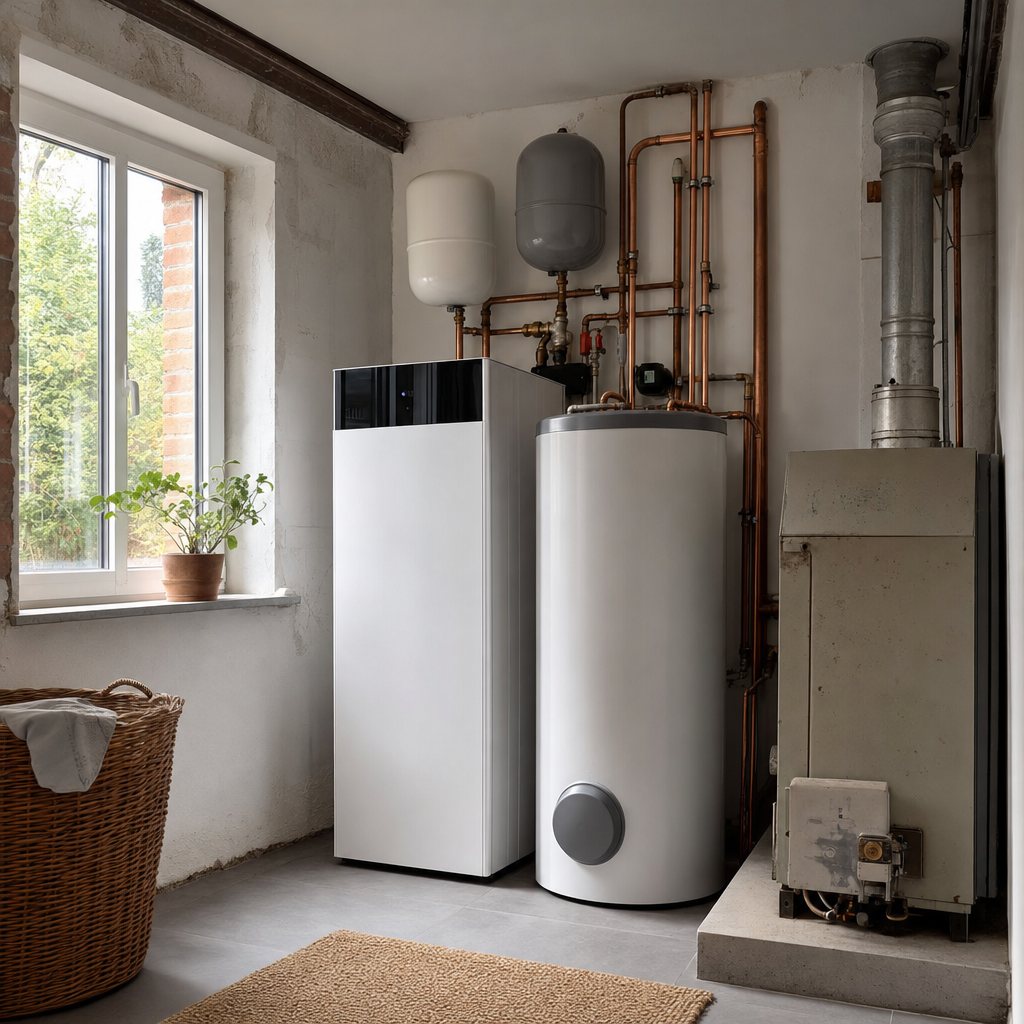
The recast EPBD ends subsidies for stand-alone fossil fuel boilers from 2025 and sets the goal of phasing them out of buildings by 2040. What is and is not banned.
Around three quarters of the energy used for heating in EU buildings still comes from fossil fuels, much of it burned in individual gas and oil boilers. The recast Energy Performance of Buildings Directive, Directive (EU) 2024/1275, does not ban these boilers outright, but it sets a clear direction: public money for them stops, new buildings must do without them, and member states must plan for a complete phase-out by 2040.
No more subsidies from 2025
From 1 January 2025, member states may no longer provide financial incentives for the installation of stand-alone boilers powered by fossil fuels. Grants, subsidised loans and similar support for replacing an old gas boiler with a new one are therefore no longer allowed, with a limited exception for investments already selected under certain EU funding programmes before that date.
Hybrid heating systems remain eligible for support. A system that combines a boiler with a significant share of renewable heat, such as a hybrid heat pump or a boiler paired with solar thermal, is not a stand-alone fossil boiler in the sense of the directive.
The 2040 goal
The directive requires member states to include in their national building renovation plans the policies and measures needed to phase out fossil fuels in heating and cooling, with a view to completely phasing out fossil fuel boilers by 2040. This is a planning obligation rather than an EU-wide installation ban: each country decides how to get there, whether through standards for heating systems, financial incentives for alternatives, local heat planning or a combination.
New buildings first
For new construction the question is effectively settled. From 2030 every new building must be a zero-emission building, which by definition causes no on-site carbon emissions from fossil fuels. A new building with a gas boiler cannot meet that standard, and public buildings face the same requirement from 2028.
National approaches
Several member states have moved earlier than the directive requires. France stopped the installation of new oil and coal heating systems in 2022. Germany’s Buildings Energy Act requires newly installed heating systems to run on at least 65% renewable energy, with the obligation for existing buildings linked to municipal heat planning. Other countries rely mainly on subsidies for heat pumps and district heating rather than restrictions on boilers. Our country profiles and the EPBD policy tracker follow these differences.
What it means for homeowners
For an existing home with a working gas boiler, nothing changes overnight. There is no EU obligation to remove a functioning boiler. What changes is the economics of replacement: when the boiler reaches the end of its life, a like-for-like replacement will no longer attract subsidies, while heat pumps, district heating connections and hybrid systems will.
The practical sequence for most homes is to improve the building envelope first, so that a heat pump can run efficiently at lower flow temperatures, and then to replace the heating system. Energy poverty is a real constraint on this path, as our analysis of energy poverty and the renovation gap shows, which is why the directive links the phase-out to targeted support for vulnerable households.
Alternatives to a fossil boiler
The main options for replacing a gas or oil boiler in an existing building are:
- Air-to-water heat pumps, the most common choice, which work with existing radiators when flow temperatures can be lowered, often after some insulation work.
- Ground-source heat pumps, more efficient and quieter but more expensive to install because of the boreholes or ground loops.
- Hybrid systems that pair a heat pump with a boiler for the coldest days, a common transition step where the building cannot yet be fully electrified.
- District heating, where a network exists or is planned, which moves the question of fuel to the network operator.
- Biomass boilers, an option in some rural areas, though their role is limited by air quality rules and the availability of sustainable fuel.
Which option is right depends on the building’s heat demand, the space available and local energy prices. An energy performance certificate with up-to-date recommendations, as discussed in our guide to EU energy performance certificates, is a useful starting point.
Supply and installation capacity
A 2040 phase-out implies tens of millions of heating system replacements over fifteen years. The pace will depend on the availability of heat pumps and installers as much as on regulation, an issue we examined in our assessment of heat pump supply chain vulnerabilities. The consolidated text of the directive and Commission guidance are available on the European Commission’s EPBD page.