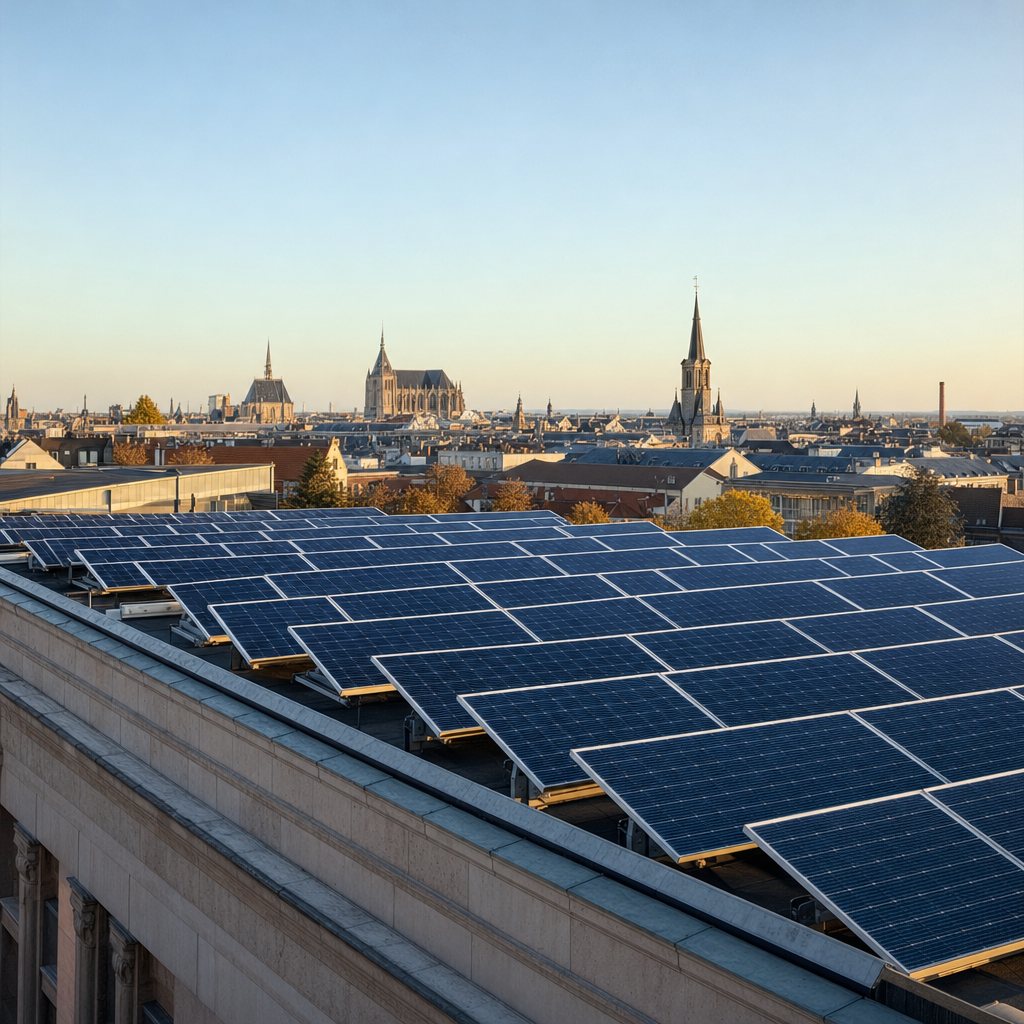
Article 10 of the recast EPBD phases in solar installations on new and existing buildings between 2026 and 2030. A timeline of who is covered and when.
The recast Energy Performance of Buildings Directive, Directive (EU) 2024/1275, contains the EU’s first general requirement to put solar energy installations on buildings. The obligation is phased in between the end of 2026 and the end of 2030 and covers new buildings of all types as well as large existing public and commercial buildings.
The principle
Member states must ensure that new buildings are designed to optimise their solar energy generation potential, based on the solar irradiance of the site, so that solar installations can be added cost-effectively later if they are not installed at once. On top of this design duty, the directive sets dates by which suitable solar energy installations must actually be deployed, provided this is technically suitable and economically and functionally feasible.
The timeline
- By 31 December 2026: all new public buildings and new non-residential buildings with a useful floor area above 250 square metres.
- By 31 December 2027: existing public buildings above 2,000 square metres, and existing non-residential buildings above 500 square metres when they undergo a major renovation or works that require a permit, such as roof works or the installation of a technical building system.
- By 31 December 2028: existing public buildings above 750 square metres.
- By 31 December 2029: all new residential buildings, and all new roofed car parks physically adjacent to buildings.
- By 31 December 2030: existing public buildings above 250 square metres.
Public buildings lead the way, in line with the directive’s general expectation that the public sector sets an example. Residential buildings are covered only when they are new; there is no general obligation to retrofit solar panels on existing homes.
What counts as a solar installation
The directive refers to solar energy installations rather than specifically to photovoltaic panels. Solar thermal collectors for hot water or space heating can count, as can combinations of the two. This leaves room for designs that suit the building: a block of flats with high hot-water demand may benefit more from solar thermal, while an office building with daytime electricity loads is a natural fit for photovoltaics.
Exemptions and flexibility
The feasibility condition is important. Roofs that are shaded, structurally unsuitable or too small, and buildings with heritage protection, can be exempted under national rules. Member states define the criteria and the procedure, so the practical reach of the mandate will depend on transposition. The directive also anticipates that the installation obligations will be enforced through national building permit and inspection systems rather than a separate EU procedure.
How it fits with zero-emission buildings
The solar mandate reinforces the zero-emission building standard, under which the small remaining energy demand of new buildings should be covered by renewables. On-site solar is the most direct way to meet that requirement, especially for buildings without access to renewable district heating. It also interacts with the shift to electric heating: a heat pump combined with rooftop photovoltaics reduces both emissions and grid demand, a combination discussed in our analysis of heat pump supply chains.
Practical steps for owners and developers
Even where an installation is not yet required, the design obligation applies to all new buildings. In practice a solar-ready building has:
- roof areas oriented and kept free of obstructions such as plant rooms and vents where possible;
- a roof structure designed for the additional load of panels and mounting systems;
- cable routes from the roof to the electrical room, and space for inverters, batteries or hot-water storage;
- a grid connection sized for export, or a plan for self-consumption on site.
For existing public and commercial buildings, the most efficient moment to add solar is during roof works or a major renovation, which is why the directive ties the obligation for existing non-residential buildings to those events. Combining the installations with roof insulation avoids working on the same roof twice.
Self-consumption is the other practical question. Buildings with daytime loads, such as schools, offices and shops, use most of their solar output directly. For residential buildings, battery storage, heat pumps with hot-water tanks and shared schemes for apartment blocks help to use more of the electricity on site rather than exporting it.
Transposition
As with most of the recast directive, member states had until 29 May 2026 to bring the solar provisions into national law. Several countries already had their own solar requirements for new buildings before the directive, and their rules may go further than the EU minimum. Our EPBD policy tracker follows national implementation, and the European Commission’s EPBD page provides the official text and guidance.
For developers and public owners, the key dates are close. A non-residential project receiving permits in 2026 will in most cases need to plan for solar from the start.