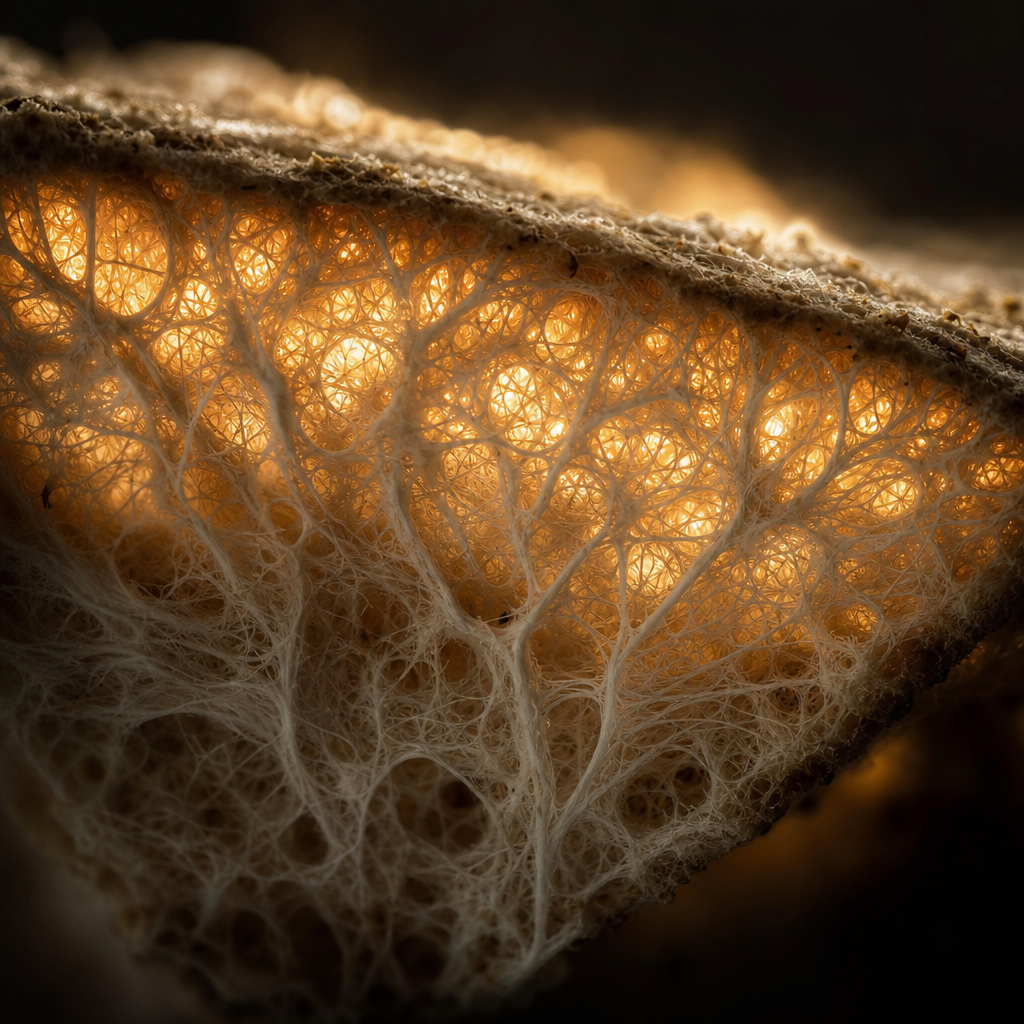
Quantitative assessment of thermal conductivity and fire resistance of next-generation organic building insulation materials.
Mycelium-based composite materials — grown by cultivating fungal hyphal networks through agricultural lignocellulosic substrates — have emerged as a candidate low-carbon building insulation technology. This paper presents the first EN 13162-compliant thermal performance characterisation of three commercial mycelium insulation products alongside conventional mineral wool and EPS benchmarks, establishing a performance baseline for regulatory and procurement purposes.
Thermal conductivity values for mycelium boards (dried at 80°C) ranged from 0.038-0.044 W/(m·K), placing them in the lower range of standard mineral wool performance (0.034-0.040 W/(m·K)) and substantially outperforming compressed straw (0.065-0.090 W/(m·K)). Fire resistance testing under EN 13501-1 returned an E classification for all three products — adequate for most non-structural applications but requiring additional treatment for applications requiring D or C classification in high-occupancy buildings.
Test Protocol and Products
Three commercial mycelium composite products were evaluated: two European manufacturers (Netherlands and Germany) and one UK producer. All three use agricultural waste substrates — corn husks, hemp hurds and softwood sawdust respectively — and the fungal species Ganoderma lucidum (Reishi) or Pleurotus ostreatus (Oyster mushroom). Boards were cured at 80°C for 48 hours to terminate mycelial growth, producing dimensionally stable panels of 50mm, 100mm and 150mm nominal thickness.
Thermal conductivity measurements followed the guarded hot plate method (EN 12667), conducted at mean temperatures of 10°C and 25°C. Density ranges across the three products were 65-115 kg/m³ — substantially lower than mineral wool (80-180 kg/m³) and EPS (10-30 kg/m³), with direct implications for structural loading in retrofit applications. The heat demand implications of mycelium insulation in wall assemblies can be modelled using the Heat Demand calculation instrument, which accepts custom U-value inputs.
Carbon Embodied Analysis
Life cycle assessment (ISO 14040/14044) covering raw material extraction, manufacturing and end-of-life disposal shows mycelium insulation achieving embodied carbon of 0.8-1.4 kgCO₂e/kg — substantially below mineral wool (2.6-4.8 kgCO₂e/kg) and EPS (3.1-5.2 kgCO₂e/kg). The primary carbon advantage derives from agricultural substrate sequestration, which partially offsets manufacturing emissions. End-of-life biodegradation fully recovers embodied carbon within 24-36 months of disposal in soil conditions.
Against the EU’s Renovation Wave decarbonisation trajectory, broader adoption of mycelium insulation in wall and roof assemblies could reduce embodied carbon in building retrofit by an estimated 0.8-1.2 million tCO₂e annually by 2030 at full deployment scale — a modest but meaningful contribution to lifecycle building decarbonisation.
Limitations and Research Gaps
Current mycelium products present limitations that constrain near-term market penetration: (1) higher manufacturing cost (€18-32/m² vs €4-11/m² for mineral wool at equivalent performance); (2) moisture sensitivity requiring vapour control layers in most climatic zones; and (3) dimensional variability between production batches that complicates specification for contractors accustomed to standardised industrial products.
Critical mineral supply chains are not a concern for mycelium insulation — a notable contrast to the electrification technologies assessed in the heat pump supply chain analysis. Agricultural substrate availability is abundant and geographically distributed across all EU member states, providing supply chain resilience advantages over synthetic alternatives dependent on petrochemical feedstocks.
Further research is required on long-term moisture performance, acoustic properties, and interoperability with render systems before mycelium insulation can be recommended for mainstream specification. The Passive House Institute’s assessment framework for novel insulation materials, available via Passive House International, provides the most rigorous current protocol for certification of materials at near-NZEB performance levels.
Outlook
Mycelium insulation is not yet a drop-in replacement for established materials, but its low embodied carbon and abundant, distributed feedstock make it a credible part of a lower-carbon retrofit toolkit. Closing the remaining gaps on cost, moisture performance and batch consistency, alongside clearer certification pathways, will determine how quickly it moves from niche specification to mainstream use in the renovation market.